AIM - RAC 1.5.3 - Radar Traffic Information
Traffic (or workload) permitting, ATC will provide IFR and CVFR flights with
information on observed radar targets whenever the traffic is likely to be of
concern to
the pilot, unless the pilot states that the information is not wanted. This
information
may be provided to VFR aircraft when requested by the pilot.
If requested by the pilot, ATC will attempt to provide radar separation between
identified IFR aircraft and the unknown observed aircraft.
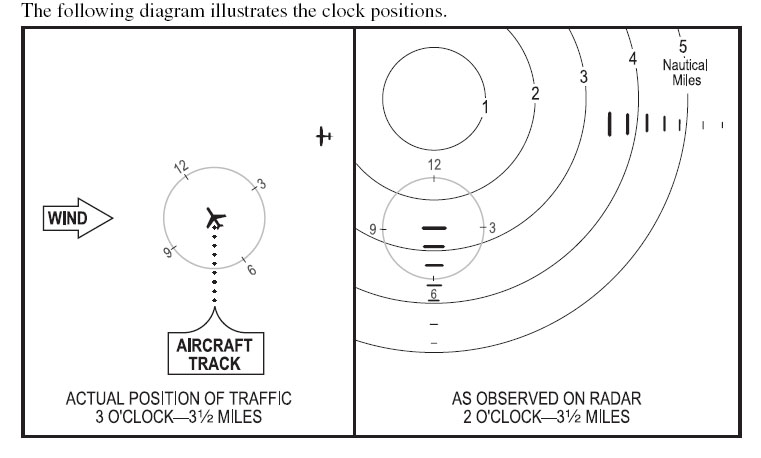
When issuing radar information, ATS units will frequently define the relative
location
of the traffic, weather areas, etc., by referring to the clock position. In this
system, the
12 o’clock position is based on the observed radar track rather than the actual
nose of
the aircraft. In conditions of strong crosswind, this can lead to a discrepancy
between
the position as reported by the controller and the position as observed by the
pilot.
Traffic information when passed to radar-identified aircraft will be
issued as follows:
1. Position of the traffic in relation to the aircraft’s observed track.
2. Direction in which the traffic is proceeding.
3. Type of aircraft and altitude, if known, or the relative speed of the
traffic.
Example: TRAFFIC, 2 O’CLOCK 3 1/2 MILES, WESTBOUND, (type of aircraft
and altitude, or relative speed).
An aircraft not radar-identified would be issued traffic information in the
following
manner:
1. Position of the traffic in relation to a fix.
2. Direction in which the traffic is proceeding.
3. Type of aircraft and altitude, if known, or relative speed.
Example: TRAFFIC, 7 MILES SOUTH OF QUÉBEC NDB, NORTHBOUND, (type
of aircraft and altitude, or relative speed).